Duty & Service
The 1840s represented a period of significant transition for Stanley Trafalgar Rawlinson — a decade in which he might even be said to have displayed a certain restlessness, as he sought to define his role in a changing empire and to reconcile his adventurous nature with the constraints of formal service.
1839–1840: A Soldier in Search of Purpose
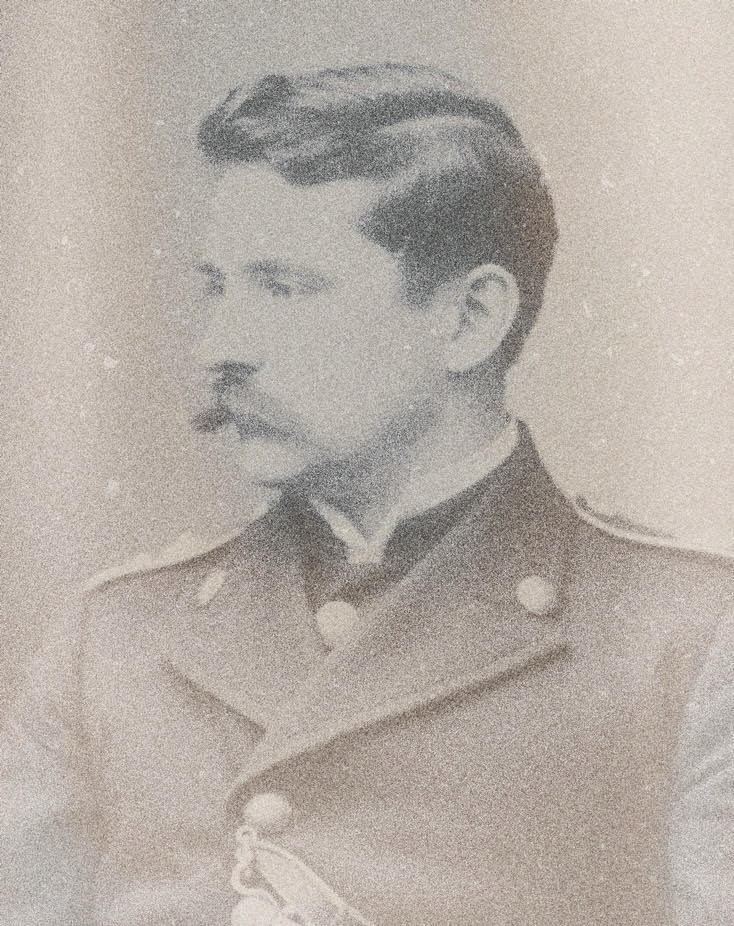
Stanley, 1843
In September 1839, fresh from his travels in Central Asia and with a modest fortune to his name, Stanley purchased a commission in the British Army at the cavalry rank of Cornet. He joined the Royal Military College at Sandhurst, at that time still a relatively new institution, for his initial officer training. Normally, cadets entered between sixteen and eighteen years of age for a two-year course of study, but Stanley, already in his mid-twenties and with extensive field experience, was accepted under an accelerated programme designed for older entrants — a sign of the Army’s growing pragmatism in professionalising its officer corps.
By contemporary accounts, Stanley excelled at Sandhurst. His reports describe him as “a man of evident intelligence and spirit, with a natural command of men and tongue for diplomacy.” He graduated in the spring of 1840 and was gazetted into the 10th Royal Hussars at the rank of First Lieutenant.
The regiment was at that time billeted in Dorchester, where Stanley’s first taste of soldiering involved the less-than-glamorous duty of aiding civil authorities in extinguishing a major fire in neighbouring Fordington. Shortly after, the regiment was redeployed to Northampton—and it was there that Stanley’s military career came to its abrupt and somewhat undistinguished conclusion.
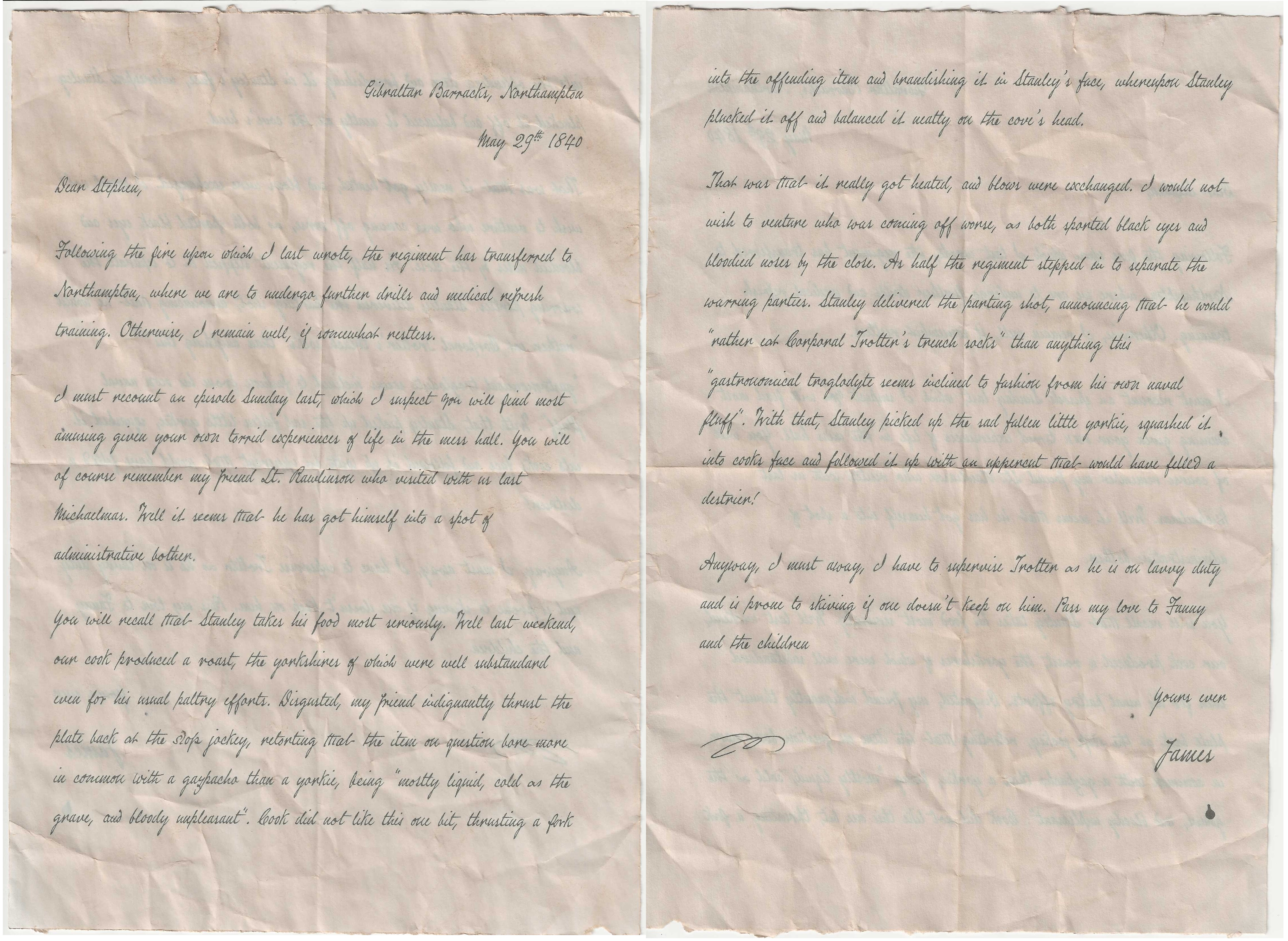
Lt. Windham's letter, 1840
The precise reasons for his resignation remain uncertain. Neither his personal letters nor the official regimental papers shed much light, but a recently surfaced letter from his close friend Lieutenant James W. Windham offers a colourful, if unflattering, account of the affair that ended it all. According to Windham:
…[Stanley] indignantly thrust the plate back at the slop jockey, retorting that the item on question bore more in common with a gazpacho than a yorkie, being ‘mostly liquid, cold as the grave, and bloody unpleasant’. Cook did not like this one bit, thrusting a fork into the offending item and brandishing it in Stanley’s face, whereupon Stanley plucked it off and balanced it neatly on the cove’s head.
That was when it really got heated, and blows were exchanged. I would not wish to venture who was coming off worse, as both sported black eyes and bloodied noses by the close. As half the regiment stepped in to separate the warring parties, Stanley delivered the parting shot, announcing that he would ‘rather eat Corporal Trotter’s trench socks’ than anything this ‘gastronomical troglodyte seems inclined to fashion from his own naval fluff’. With that, Stanley picked up the sad fallen little yorkie, squashed it into cook’s face and followed it up with an uppercut that would have felled a destrier!
Whether apocryphal or not, the story has the unmistakable ring of Stanley’s temperament — fiery, uncompromising, and possessed of a sense of honour that sometimes exceeded his patience. By June 1840, he had resigned his commission, his soldiering days over almost before they had begun.
1841: The Foreign Service Beckons
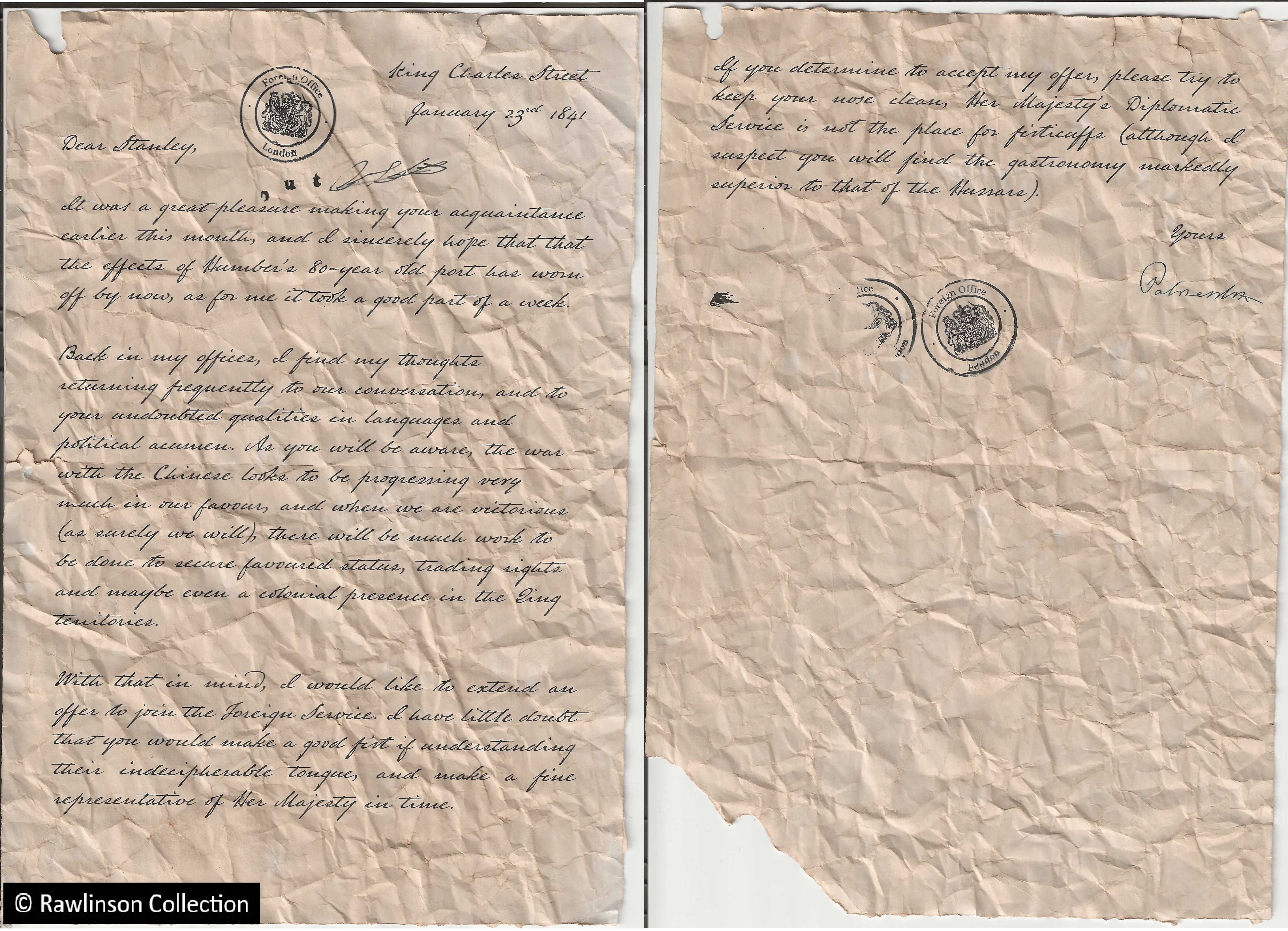
Palmerston's letter of appointment, 1841
If his departure from the Army was inglorious, his next step was fortuitous. In early 1841, Stanley first encountered the formidable political figure Henry John Temple, the 3rd Viscount Palmerston — then Foreign Secretary and soon to become one of the great architects of Victorian foreign policy.
The two men likely met at a gathering hosted by a mutual friend, Lord Humber, a Tory backbencher and old naval acquaintance of Stanley’s father. Palmerston, ever quick to recognise ability in unconventional candidates, seems to have been impressed by Stanley’s intellect and experience in Asia. A letter dated January 1841 confirms that Palmerston arranged for Stanley to enter the Foreign Service, with the expectation that he would eventually be posted to Hong Kong.
That same year, however, the Whig government fell following a vote of no confidence, and Palmerston was briefly cast to the Opposition benches. Yet Stanley’s appointment survived the political upheaval, suggesting his selection had merit beyond patronage alone.
1842–1846: The Hong Kong Years
Stanley’s entry into the diplomatic corps coincided with the closing stages of the First Opium War (1839–1842), in which two of his brothers served — one fatally. As Britain consolidated its influence in China, the cession of Hong Kong Island was agreed in January 1841, though formal ratification would not come until the Treaty of Nanking in August 1842.
Stanley departed for the East in December 1841, enduring the months-long sea voyage via the Cape before finally disembarking at Hong Kong in May 1842. As a junior official, he played no major role in the treaty negotiations but was present at the signing aboard HMS Cornwallis, an event immortalised in a painting by Captain John Platt, in which a faintly recognisable Stanley appears in the background — a mere observer to history, but already part of its fabric.
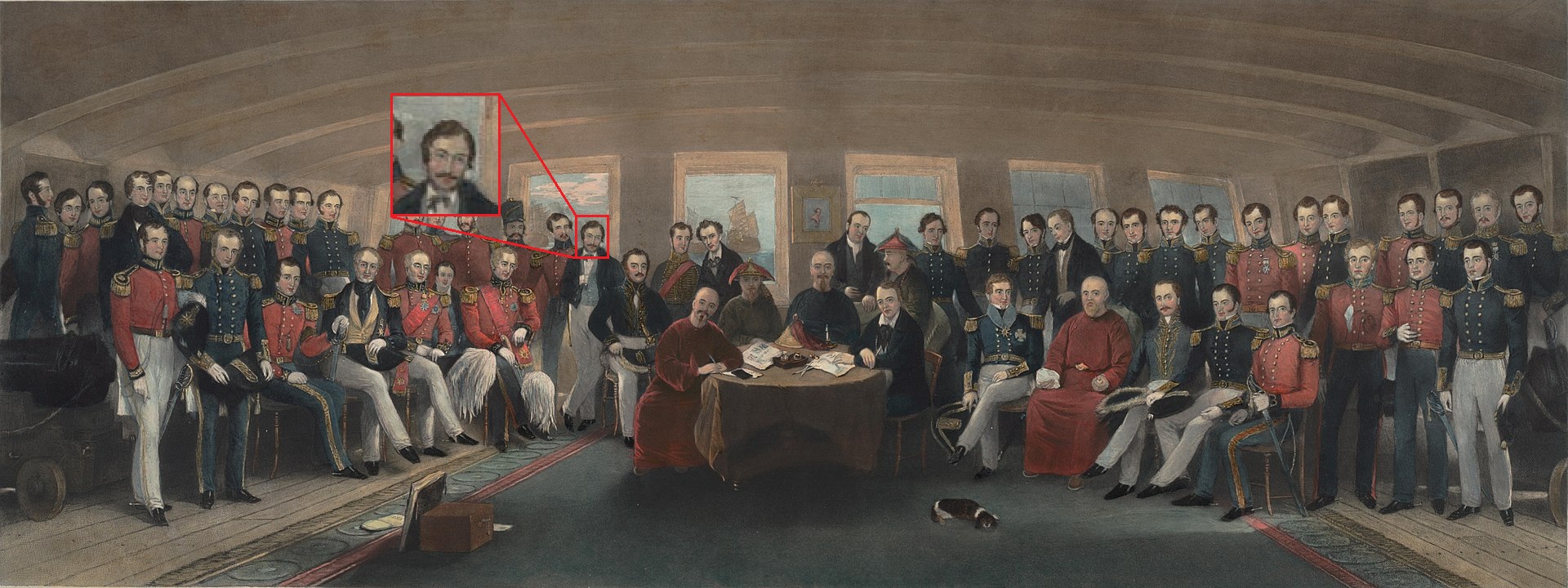
Nanking, 1842
Under the administration of Sir Henry Pottinger, Hong Kong rapidly transformed from a barren outpost into a nascent entrepôt of empire. Rawlinson’s early work, though modest, likely involved translation, liaison with Chinese intermediaries, and the drafting of minor agreements. It was here that his linguistic facility — including his knowledge of Pashto and Persian — earned him respect among colleagues.
Yet even amid these bureaucratic endeavours, his propensity for mischief resurfaced in what became known, much later, as “The Crème Brûlée Affair.”
The Crème Brûlée Affair (1844)
While attending negotiations in Peking in early 1844, Stanley joined a soirée at the residence of the French Military Attaché. Two days later, the attaché reported his personal chef missing. Months later, the very same man was discovered happily employed as Stanley’s cook in Hong Kong.
Stanley denied all wrongdoing, claiming ignorance of the chef’s past service — but the French lodged formal diplomatic protests. The French Ambassador in London demanded Stanley’s dismissal, and the British Ambassador in Paris found his dachshund, “Nibbles,” mysteriously abducted by a zealous junior French diplomat in apparent retaliation.
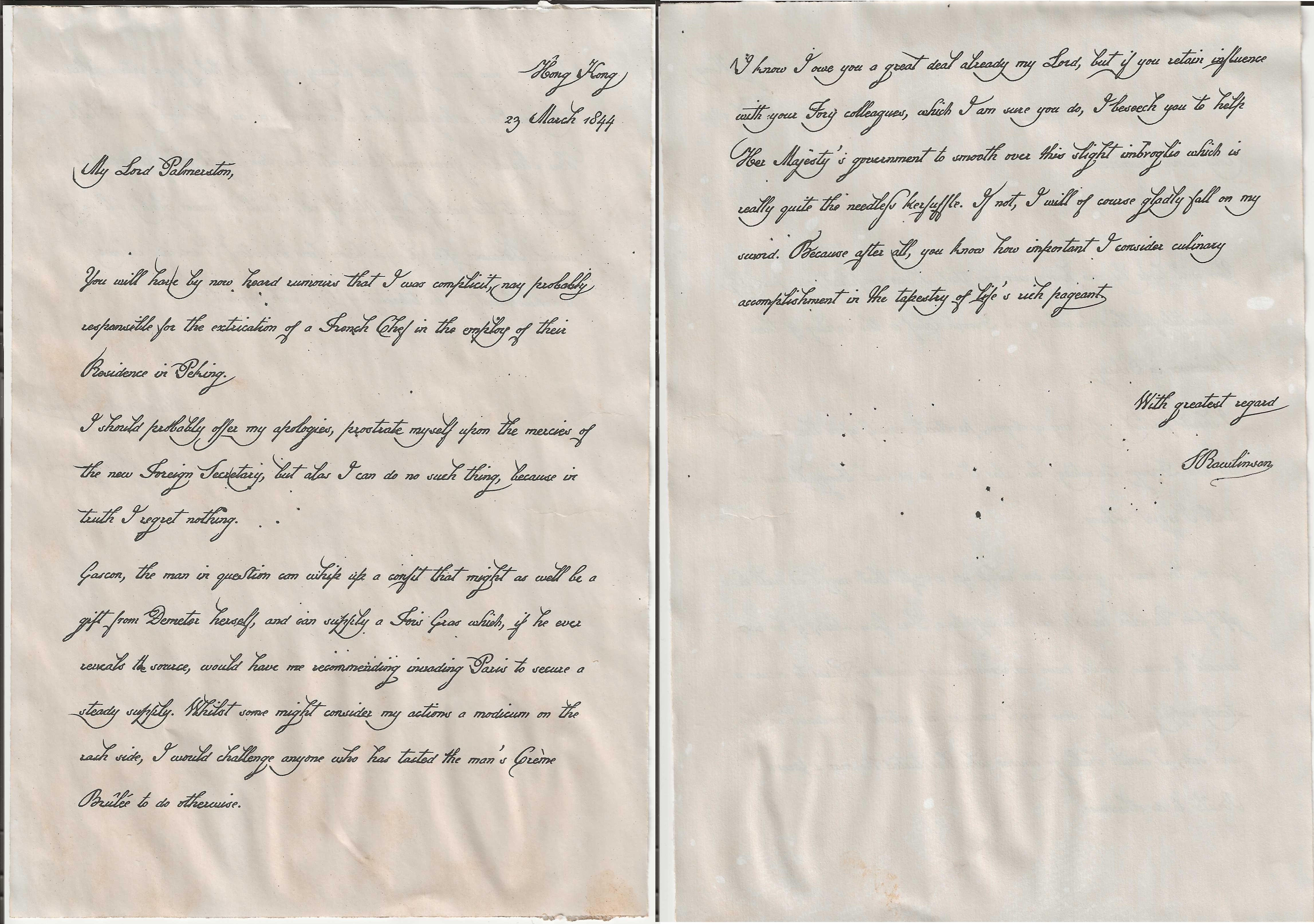
Stanley's letter to Palmerston, 1844
After weeks of escalating farce, the crisis was resolved through a night-time “prisoner swap” — the chef returned to his former master in exchange for the dog. The affair required high-level intervention: Palmerston himself (by then in Opposition) reportedly called in a favour from the Foreign Secretary, Lord Aberdeen, who in turn wrote a personal letter of apology to King Louis-Philippe.
Newly discovered correspondence, however, reveals that Stanley was guilty as charged. In a wry and utterly unrepentant letter to Palmerston, he confessed:
“…the man can whip up a confit that might as well be a gift from Demeter herself, and can supply a foie gras which, if he ever reveals its source, would have me recommending invading Paris to secure a steady supply. Whilst some might consider my actions a modicum on the rash side, I would challenge anyone who has tasted the man’s crème brûlée to do otherwise!”
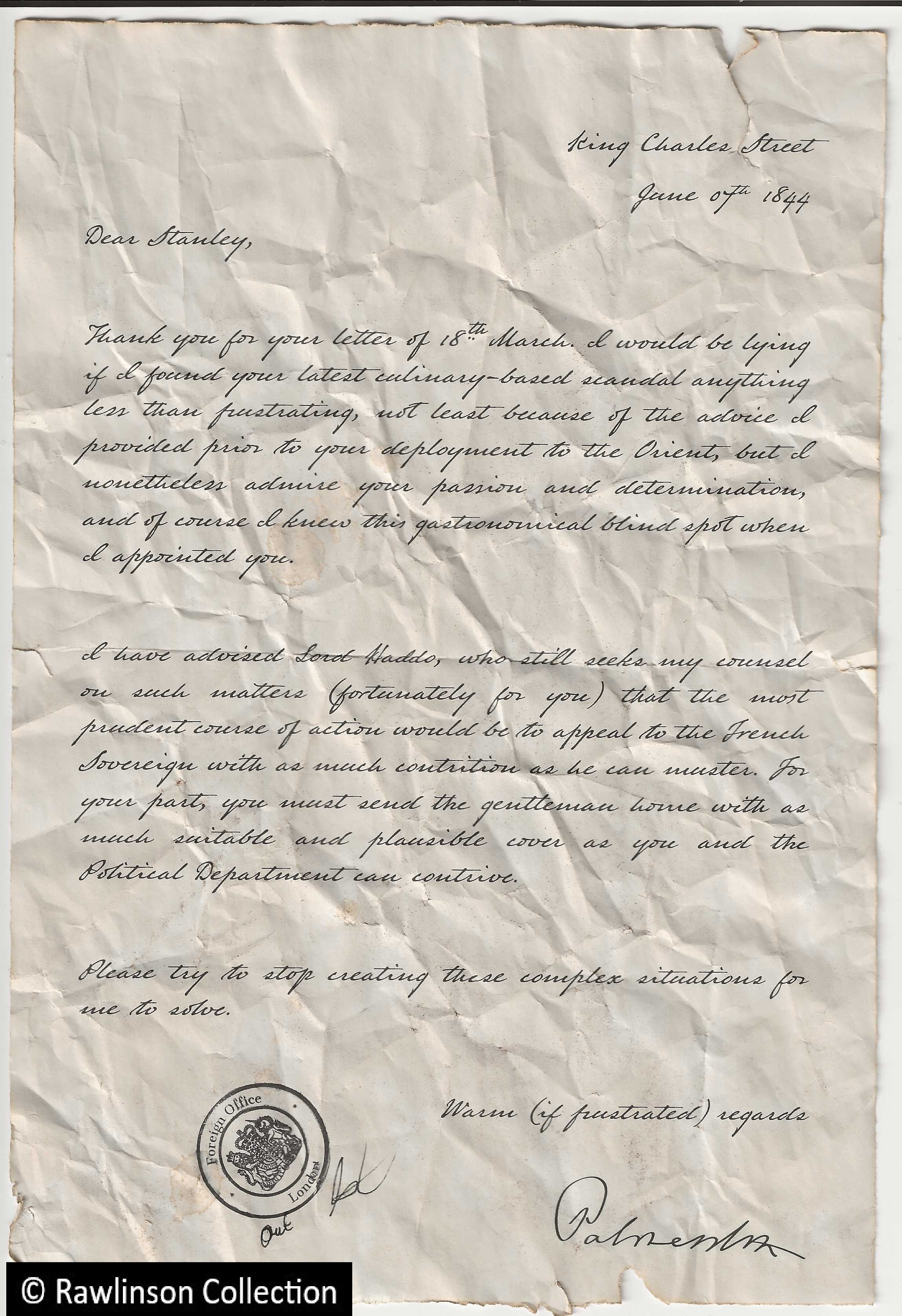
Palmerston's reply, 1844
The letter, though intended privately, has since become a favourite among Rawlinson’s admirers — a testament to his unquenchable wit and his incurable appetite for trouble.
A Damnedly Hard Bargain
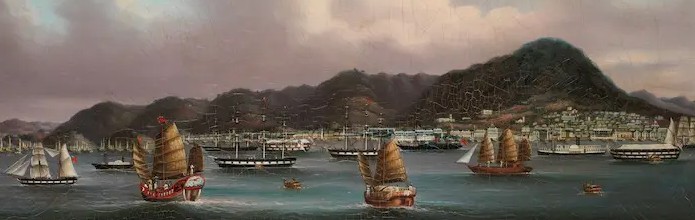
Despite his occasional indiscretions, Stanley continued to rise quietly through the ranks of the Foreign Service. He took part in implementing the Treaty of the Bogue (1843) and other follow-on agreements, which established formal trade and diplomatic privileges for Britain in China’s key coastal ports.
In a letter to his elder brother, he reflected on the challenges of dealing with the Chinese negotiators:
“Whilst we should be rightly pleased with the end result, securing a presence for the Empire in a number of key ports including Shanghai, I should note with begrudging deference that the Chinese drive a damnedly hard bargain. Whilst military superiority clearly gave us the bargaining hand we needed, we should watch them closely, because should they ever get their bloody act together, the Chinese will prove a more than capable global competitor.
It is a strikingly prescient observation — and one that underscores Stanley’s habit of perceiving the world in broader, more strategic terms than most of his contemporaries.
Return to London, 1846–1849

Internal FO memo, 1846
In 1846, Stanley left Hong Kong and returned to London, travelling via the Cape of Good Hope — a voyage that took over six months. On his return, he sent a characteristically acerbic memorandum to the Foreign Office Director of Budgetary Responsibility, criticising the department’s short-sighted fiscal decisions:
The office’s purblind and myopic approach to financial propriety. The absence of which, had my proposal to overland across the Suez Isthmus been approved, would have returned a month or more of my precious time to your precious coffers, more than offsetting the cost of the upgrade.
Though his tone did him few favours with superiors, it suggests a man already thinking ahead to the great overland routes that would later revolutionise travel and communication between Europe and Asia.
The years following his return were marked by extensive travel across Europe, much of it in official or semi-official capacity. While documentation remains sparse, it is evident that he maintained close contact with senior Foreign Office figures — and, crucially, with Lord Palmerston, whose star was again on the rise.