
Poetry
"The Lyricist of Luton"
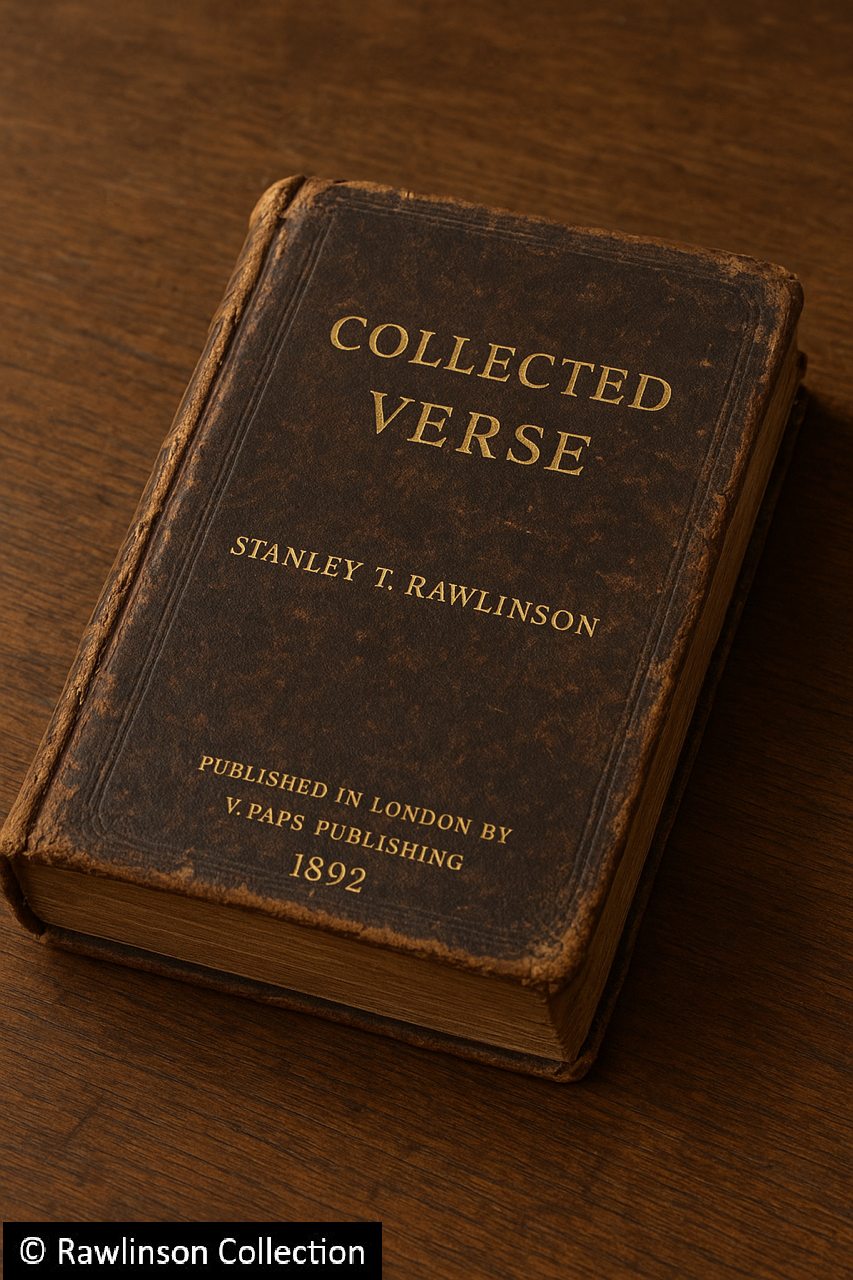
Collected Verse (1906)
Stanley's dalliance with poetry began, characteristically, far from home — during his American tour of 1887–1888. Amid the clamour of banquets and lecture halls, he found unexpected solace in verse, producing a prolific and perplexing body of work that ranged from haiku to the notorious thousand-line epic America is Wasted on the Americans. Over the years that followed, poetry became for him both a diversion and an outlet — the inkstand equivalent of fencing practice.
A few of his shorter works found their way into the pages of Punch and other periodicals, where their gleeful skewering of political pomposity drew modest attention. Yet the vast majority of his verses remained tucked away in drawers and notebooks until the improbable publication of Collected Verse in 1906 — a weighty volume that arrived, unheralded and largely unwanted, into Edwardian drawing rooms.
The collection, as one contemporary put it, was "sometimes passionate, often satirical, and always irreverent." What it was not — alas — was popular. Sales were disastrous; indeed, as far as can be traced, only two copies are known to survive: one in the British Library, and the other in the Rawlinson Collection itself. The critics, seldom kind to late-blooming poets, were merciless. Some accused him of "attempting to yoke Byron to a hansom cab," while another reviewer suggested that the book "ought to have been privately buried rather than publicly printed."
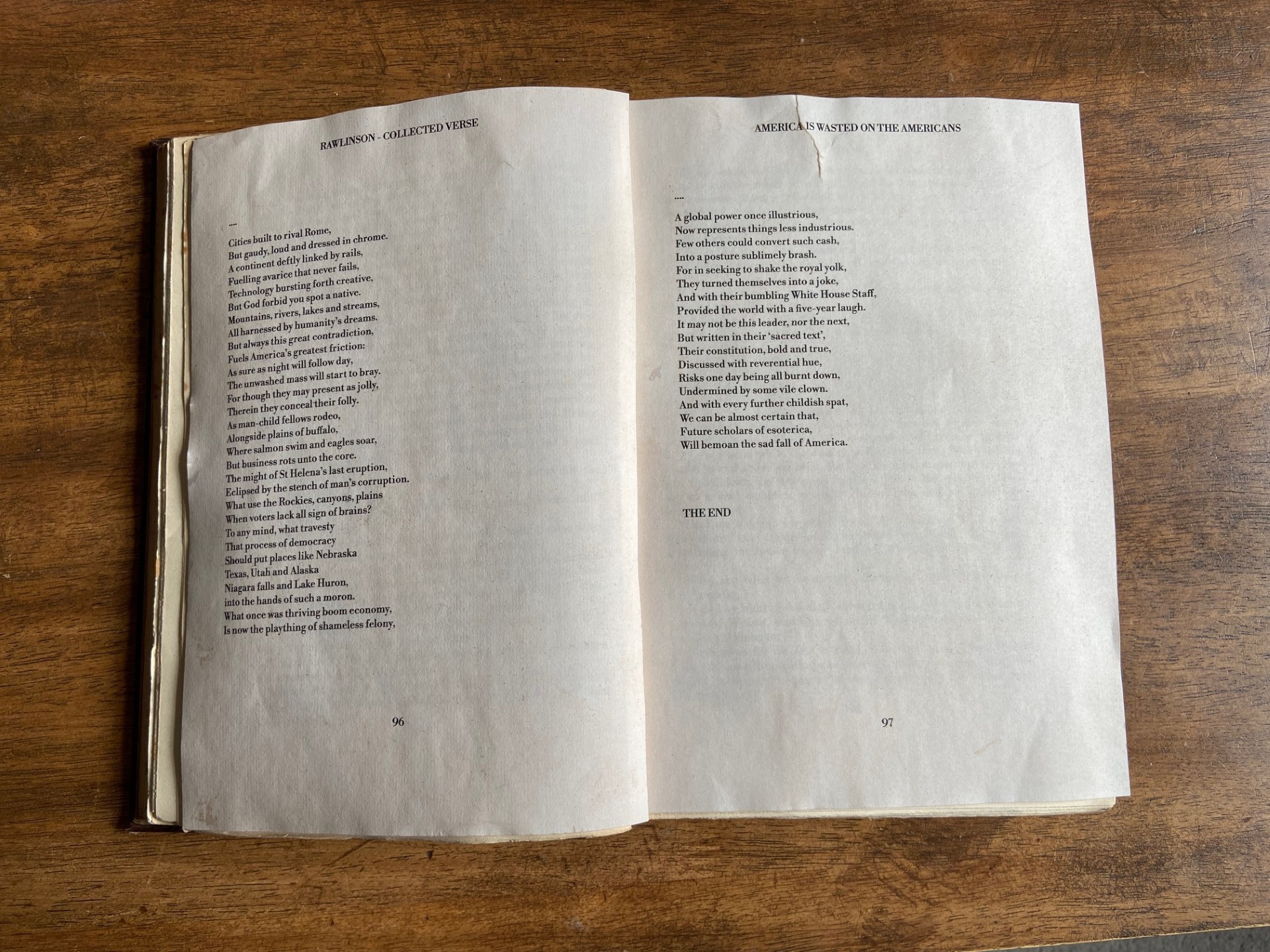
Collected Verse (1906)
Stanley, outwardly at least, bore this drubbing with good humour. There is no record of him expressing disappointment, though he never again published a line of verse. Friends later recalled him jesting that the reviews had "saved the English language from a terrible fate."
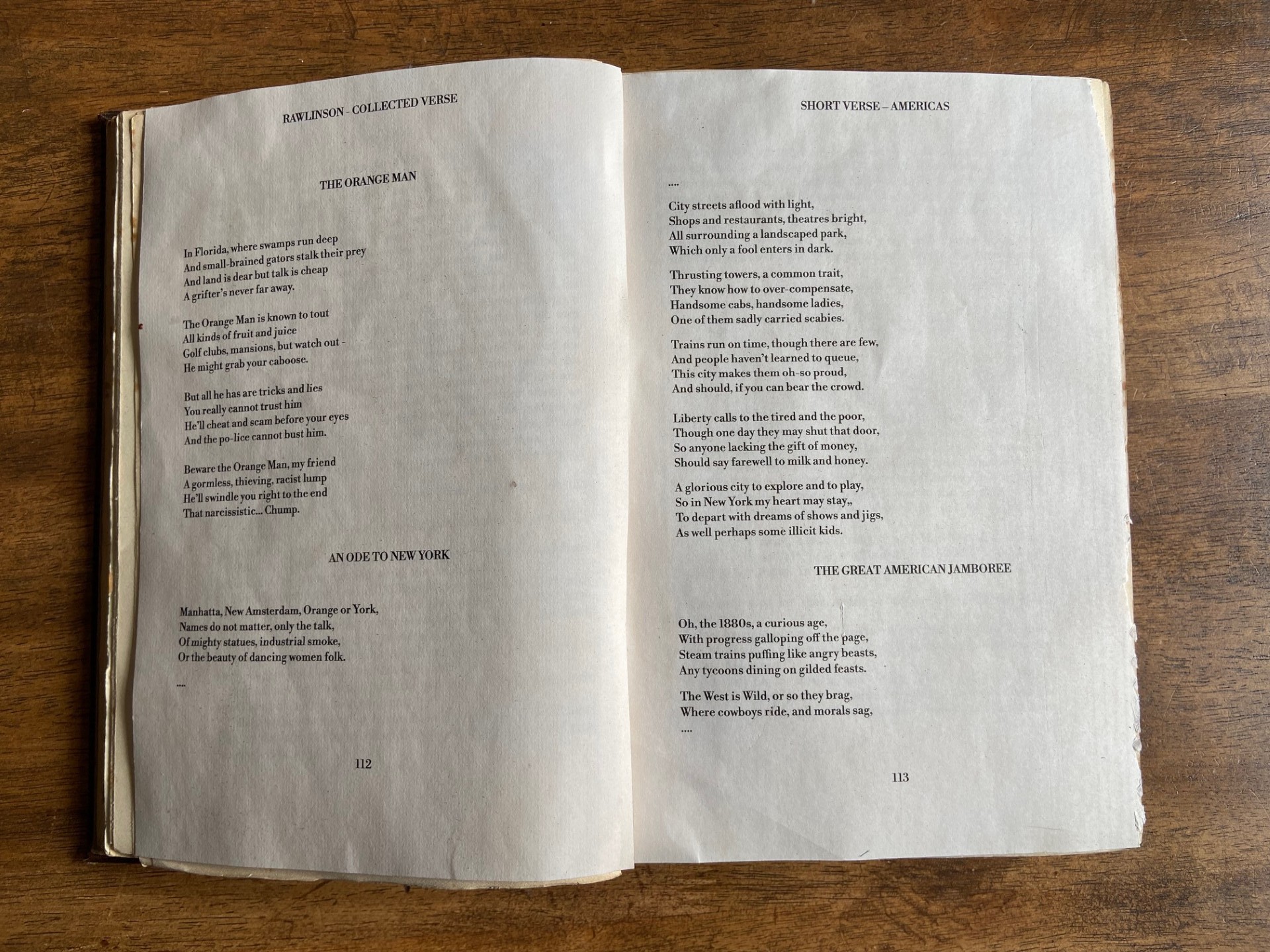
Collected Verse (1906)
Yet amid the general carnage of critical opinion, one faint light flickered — the Literary Editor of the East Claydon Gazette, who bravely championed Stanley's cause. This solitary act of defiance provoked a heated exchange of letters with an indignant local resident, an argument so spirited that it remains, to this day, perhaps the most exciting cultural episode ever to trouble the peace of East Claydon.
Below, we reproduce a selection of those reviews — savage, sympathetic, and delightfully unrestrained — together with the now-legendary Gazette correspondence.
Reviews
"The Exhaustion of English Verse: Sir Stanley Rawlinson's regrettable anthology Collected Verse — a title more ambitious than accurate — offers nearly five hundred pages of poems which prove chiefly that industriousness is no substitute for inspiration. His shorter compositions, including a profusion of so-called 'Haiku,' resemble the note-book jottings of an undergraduate philosopher with a broken clock; while his long poem, America is wasted on the Americans, achieves the singular feat of being both tedious and incomprehensible. The poet's wit, when not about food, is about women, and when not about women, is indigestible.
"It reads," remarks The Westminster Gazette, "as though a man had swallowed a rhyming dictionary and been violently seasick upon the page."
The volume closes with an index, but none to the author's meaning.
— Times Literary Supplement, London
"A British Knight Takes on America — and Loses: In Collected Verse, Sir Stanley Rawlinson offers the American public an epic insult wrapped in tedium. His thousand-line poem, America is wasted on the Americans, might have been written after a long lunch and an even longer prejudice. His 'political musings' whilst undoubtedly informed, are blunt instruments, and his 'haiku' would shame a schoolchild.
One hopes he will henceforth confine his energies to something less public — say, gardening or silence."
— New York Times
"A Heavy Book with a Hollow Heart: Sir Stanley Rawlinson's Collected Verse arrives with the pomp of knighthood and the weight of 480 pages, but precious little else. His political poems are the work of a man who has read much and understood little; his food verses are so overcooked one can scarcely chew them; and his verses on women suggest a gallantry gone badly to seed. As for his epic — if America is wasted on the Americans, then poetry is wasted on Sir Stanley."
— Toronto Globe, Canada
"Verse Without Vision: There are few things more dispiriting than a thick book of thin poetry. Sir Stanley Rawlinson's Collected Verse proves that ink and industry alone do not make a poet. His shorter efforts are trifles without sparkle; his haiku read as though translated by a man who has never met a Japanese person nor a syllable. His reference to our country as an 'extended commune of inbred marsupial-botherers' is hardly likely to have precipitated anything other than the harshest of reviews, although we were surprised to have reached that quote by page 362.
The so-called epic America is wasted on the Americans is an endurance trial, not a poem. It is doubtful whether even the Americans deserve it."
— Sydney Morning Herald, Australia
"On the Limits of Diligence: The volume before us raises an old question: can poetry exist without poetry? Sir Stanley writes of politics as though they were puddings, of puddings as though they were politics, and of women as though he had once seen (and probably pursued) one from across the street. His so-called epic is merely a sermon on civilization's decline, delivered without rhythm, insight, or mercy.
As Mr Chesterton observed over tea at the Authors' Club, 'Rawlinson's muse appears to wear an apron and a frown.'
We can only hope it is his last."
— The Spectator, London
The East Claydon Kerfuffle
Published in 'Literary Notes', East Claydon Gazette, February 22nd 1906
"A Noble Effort by Our Distinguished Countryman: It is with a sense of pride and neighbourly affection that we greet Sir Stanley Rawlinson's Collected Verse, a volume which — though already admired in London drawing rooms — must surely command a special reverence here in the countryside that nurtured his youth.
The book's great variety, from the shortest of his 'Hai-koos' to the stately progress of his thousand-line masterpiece America is wasted on the Americans, displays a mind both lofty and capacious. In his political verses, Sir Stanley demonstrates a courage sadly rare among modern poets; in his reflections on food, a humanity that speaks to every dinner table; and in his poems on women, a tenderness both knightly and sincere.
As Miss C. H. Pemberton observed at last week's Literary Circle, 'No one has captured the sentiment of a boiled egg quite so movingly since Wordsworth wrote of daffodils.'
The reviewers in the great metropolitan papers have been unkind, perhaps too much so. For those of us who prefer poetry with both backbone and breakfast, Collected Verse is a triumph. We commend it warmly to our readers — especially to those with long winter evenings ahead."
— East Claydon Gazette (Bedfordshire)
Letter to the Editor, East Claydon Gazette, March 3rd, 1906
Sir, — As a long-time reader of your estimable journal, and one who has always admired its judicious restraint in literary matters, I feel compelled to express a note of dismay regarding the recent and somewhat extravagant praise lavished upon Collected Verse by Sir Stanley Rawlinson.
While none would dispute Sir Stanley's eminence in parish and national affairs — his remarks at the Horticultural Dinner were much admired — it must be confessed that his poetry is of a kind not easily distinguished from weather reports, save that the latter are occasionally accurate. I have attempted to read his celebrated 'Haikoos' aloud to my wife, but they appear to have been composed in a fit of arithmetic rather than inspiration. As for the long poem about America, it is difficult to say whether it insults the Americans or merely misunderstands them.
I beg therefore to suggest that your reviewer, Miss Pemberton, may have allowed patriotic sentiment to cloud her aesthetic judgment.
— Randolph P Rogers, A Lover of Genuine Verse, Botolph Claydon, near Petersfield
Editor's Reply, Literary Notes column, East Claydon Gazette, March 10th, 1906
We print elsewhere a letter from our correspondent styling himself A Lover of Genuine Verse, whose objections to Sir Stanley Rawlinson's Collected Verse seem to arise less from the poet's work than from a certain reluctance to recognise genius when it strolls past the vicarage gate. It may be that some of Sir Stanley's subtler rhythms escape the untrained ear; that his 'Haikoos,' so unaccountably ridiculed, are not sums to be solved but petals to be gathered. To complain that they are brief is like faulting a diamond for not being larger.
As for America is wasted on the Americans, we venture to say that history will one day applaud its courage, if not its punctuation.
We shall continue to maintain that Sir Stanley's poetry nourishes both heart and intellect, and we encourage all who doubt it to hear his public reading next Thursday evening at the Temperance Hall (admission sixpence, reserved chairs ninepence).
— C. H. Pemberton, Literary Editor
Reported by our Cultural Correspondent, March 17th, 1906
The Temperance Hall was the scene on Thursday evening of a most notable literary occasion, when our distinguished local poet, Sir Stanley Rawlinson, gave a public reading from his recently published Collected Verse. Despite unseasonably damp conditions and the concurrent Whist Drive at the Mechanics' Institute, an audience of nearly two dozen assembled to hear Sir Stanley declaim selections from his work.
Proceedings opened promptly at half past seven with a few words of introduction from Miss C. H. Pemberton, who reminded us that "genius, like Jerusalem artichokes, is not always easily digested, but invariably nutritious." Sir Stanley then read several of his "Haikoos," pausing between each to explain their "Oriental compression." One, concerning a suet pudding, was received in respectful silence; another, on the subject of Parliamentary reform, drew polite coughing.
The evening's centrepiece was, of course, a portion of the great epic America is wasted on the Americans. This proved a taxing experience for both reader and audience, the work's thousand lines being neither abridged nor hurried. At approximately line 612, the caretaker was obliged to rekindle the lamps, and a small child was removed after repeated enquiries as to "whether it was nearly done."
The poet concluded to modest applause, after which Mrs. Harbottle distributed seed cake and tea (the latter somewhat tepid). In his closing remarks, Sir Stanley thanked "the attentive spirit of Little Tilling," and hinted at a forthcoming companion volume tentatively titled The Banquet of Nations.
Editorial Note: It is reported that a number of copies of Collected Verse were sold after the reading, chiefly to relatives.